

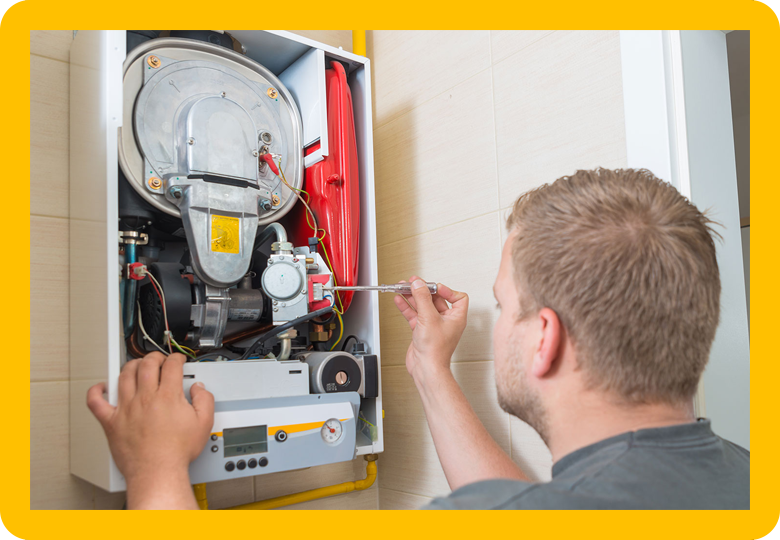


If boiler pressure keeps dropping, the system is losing pressure through leakage, relief discharge, air removal, expansion-tank problems or another hydraulic fault. Repeatedly adding water may restore pressure temporarily, but it does not identify the cause.
What Boiler Pressure Should Do
Closed-loop hydronic systems normally operate within a manufacturer-specified pressure range. Pressure rises as water heats and falls as it cools, but the change should be controlled and repeatable.
1. Visible or Hidden Water Leaks
Leaks may occur at valves, pump flanges, fittings, automatic air vents, boiler components or concealed piping. Small leaks can evaporate on hot surfaces and leave mineral residue instead of a puddle.
2. Expansion Tank Problems
The expansion tank absorbs the increase in water volume as system temperature rises. If the tank loses air charge or the diaphragm fails, pressure can swing excessively and trigger the relief valve. When the system cools again, pressure may then appear too low.
3. Relief Valve Discharge
A relief valve may open because pressure becomes excessive or because the valve itself is contaminated or damaged. The discharge pipe should be inspected for evidence of water release. The underlying cause must be found before replacing the valve.
4. Automatic Air Vents
Air separators and automatic vents remove trapped air, but a leaking vent can also lose water. A vent that repeatedly wets the surrounding area or leaves scale deposits should be inspected.
5. Fill Valve or Pressure-Reducing Valve Issues
The automatic fill assembly maintains cold system pressure. A restricted, misadjusted or failed pressure-reducing valve may not restore normal pressure after minor water loss. A valve stuck open can create the opposite problem and contribute to overpressure.
6. Air in the System
When air is purged from radiation or piping, system pressure can fall because trapped air is being replaced by water. Repeated air accumulation may point to low pressure, expansion-tank issues, leaks or air entering through components.
Diagnostic Sequence
- Record pressure when cold and when fully hot
- Inspect relief discharge and visible joints
- Check expansion-tank condition and charge where applicable
- Verify automatic fill-valve operation
- Inspect air vents and separators
- Check pumps, valves and boiler heat exchanger for leakage
Why Constantly Adding Water Is a Problem
Fresh make-up water introduces oxygen and minerals. Frequent refilling can accelerate corrosion and scaling in a hydronic system. The cause of pressure loss should therefore be corrected rather than managed indefinitely with repeated filling.
Royal Pro Heating Boiler Diagnostics
Royal Pro Heating Ltd. provides boiler repair and diagnostic service throughout Metro Vancouver. For related cycling issues, see our boiler short-cycling guide.
Frequently Asked Questions
Can a bad expansion tank make pressure drop?
Yes. A failed tank can cause large pressure swings and relief-valve discharge, leaving the system low when it cools.
Is low boiler pressure always caused by a leak?
No. Relief discharge, air elimination, fill-valve faults and expansion-tank problems can also reduce pressure.
Should I keep topping up the boiler?
Only as a temporary measure when appropriate for the system. Recurring pressure loss needs diagnosis.
Bottom Line
Boiler pressure loss should be diagnosed by comparing cold and hot pressure, checking the expansion system, inspecting relief discharge and tracing water loss. A systematic hydraulic diagnosis is more reliable than replacing components by guesswork.


